
Pricing labor without guessing
Most shops price a repair from three things: what they charged last time, what the place down the road charges, and what the customer's face did when they heard the number. That is not carelessness. It is the only method available to somebody who has no record of how long the work actually took.
The specific way it goes wrong
You do not lose money evenly. You lose it on a subset, and the subset is invisible.
In the shop I worked in, my honest estimate — and this is my memory of one shop, not a survey of anything — was that we lost money on roughly a third of jobs. What made it durable was that it was always the same third, and we could never name them.
The reason is a memory problem rather than an arithmetic one. Jobs that run long are the jobs you least accurately remember. A repair that turned into three hours because the seized part had to be drilled out does not file itself in your head as three hours. It files itself as that annoying one, and next time somebody brings in the same job you quote the same number, because the number you remember is the price you charged, not the time it took.
So the error reproduces itself. Every quarter, on the same work.
The method
Eight weeks, and you change nothing.
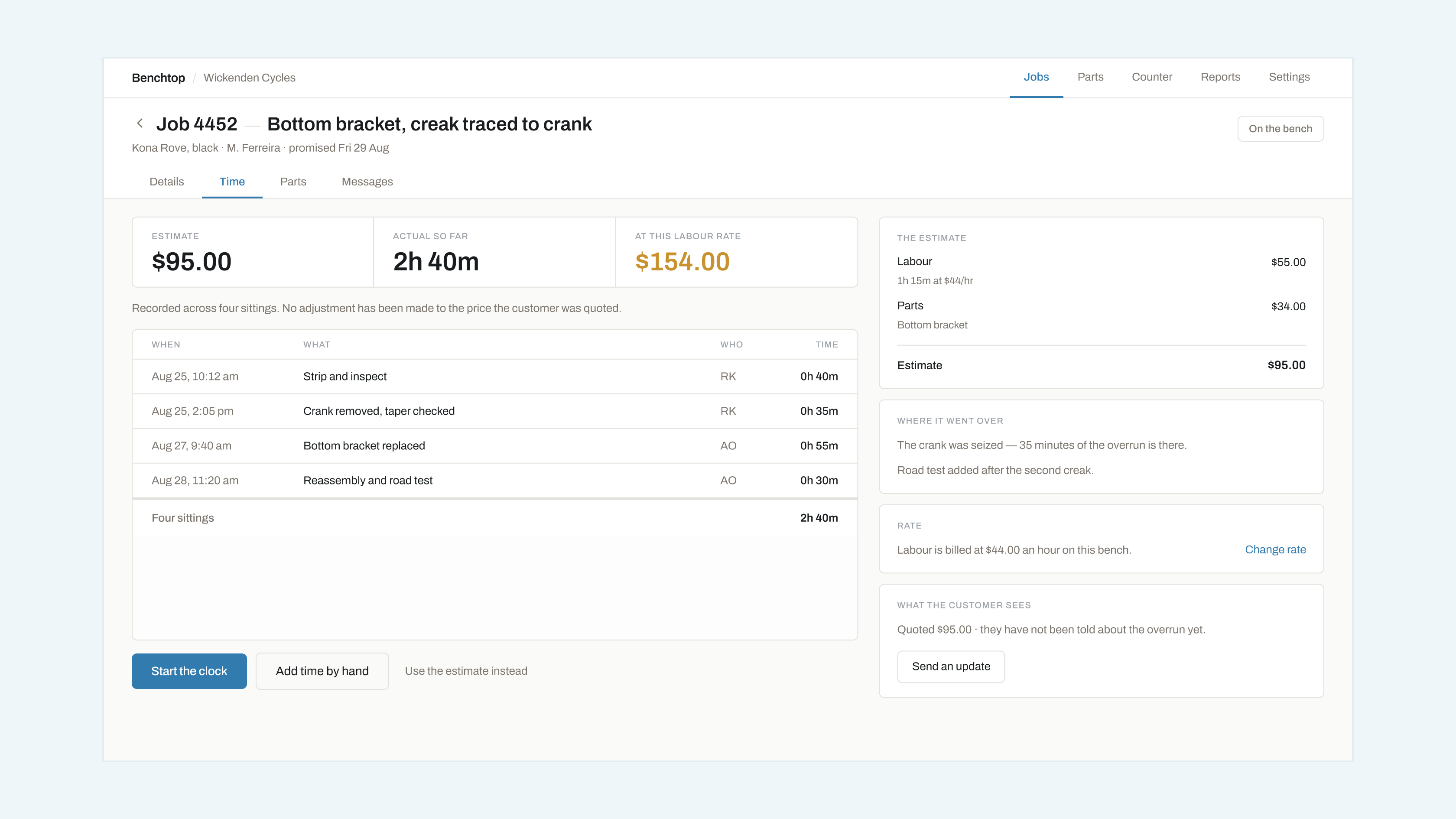
Record actual bench time against every job. Not estimates, not a guess at the end of the day — the clock running while somebody is working on the thing. Every system that does this does it slightly differently and the mechanism does not matter much, as long as it is not a person filling in a timesheet on Friday about Monday.
Do not change any price while you are measuring. This is the discipline that makes it work and it is the one people break. If you adjust prices as you go you have nothing to compare against and you will convince yourself you have fixed something.
After eight weeks, sort by the gap. For every job type: what you quoted, what it actually took at your own labour rate, and the difference. Not the average — the sorted list, top to bottom.
The eight weeks is not arbitrary. Under about six you get seasonal noise; over about twelve you stop paying attention.
A worked example
This is an illustration, using round numbers, not data from anywhere:
| Job type | Quoted | Actual, at $58/hr | Gap |
|---|---|---|---|
| Puncture, rear | $18 | $14 | **+$4** |
| Full service | $95 | $102 | −$7 |
| Wheel build, 32h | $140 | $131 | **+$9** |
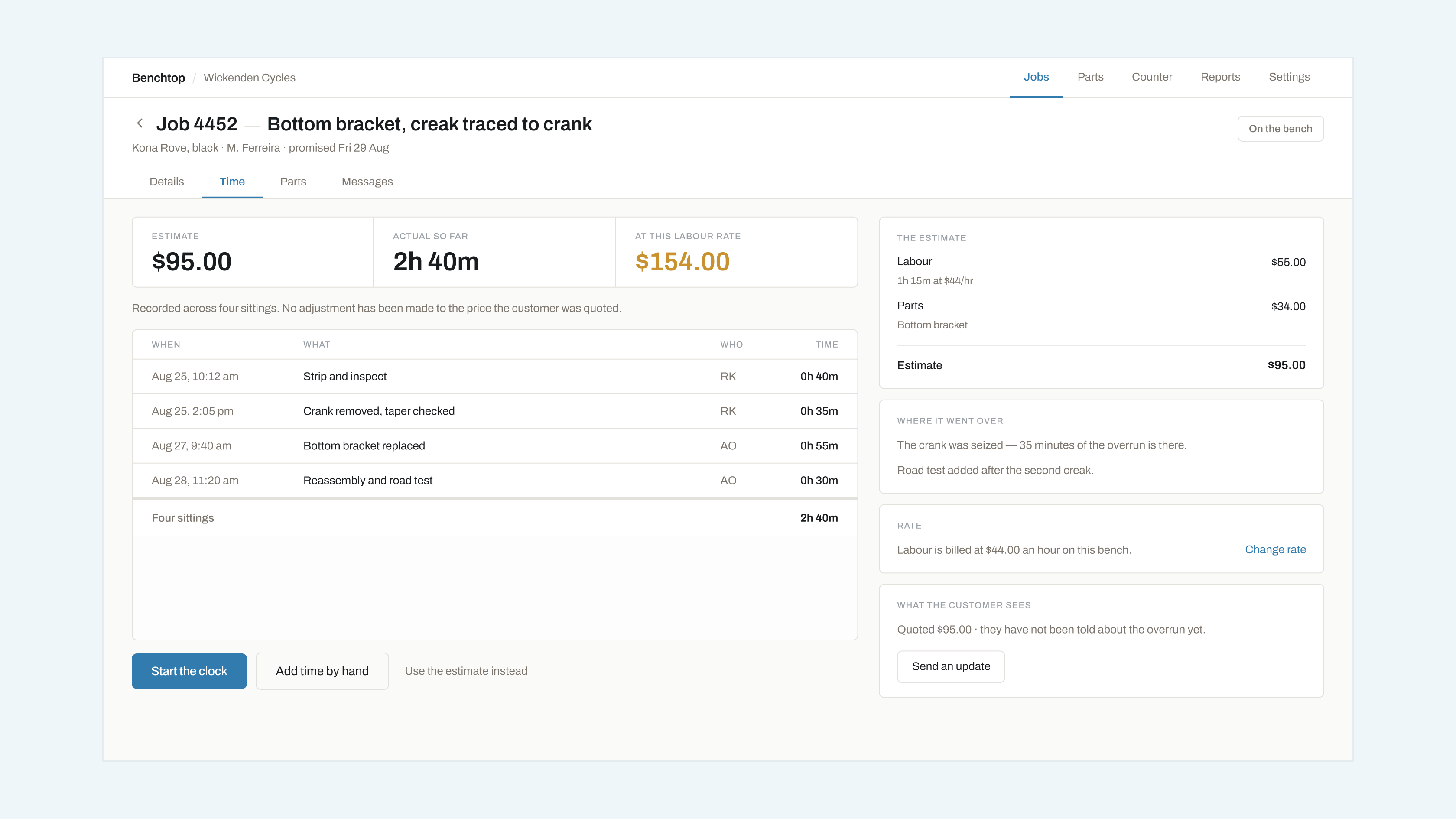
| Bottom bracket replacement | $95 | $154 | **−$59** |
| Hydraulic brake bleed | $45 | $71 | **−$26** |
| Gear cable and index | $35 | $33 | +$2 |
Six rows, two of them losing money badly. The interesting thing, every time I have watched a shop do this, is which two.
Nobody guesses the bottom bracket. Everybody assumes the full service is the problem, because it is the big obvious one and it feels heavy. It is nearly fine. The damage is in the two jobs that are quick when they are quick and catastrophic when they are not — the ones with a seized component in the middle of them.
What to do with the answer
Three options, and almost every shop reaches for the first.
Raise the price. Fine, and often right. The thing to raise is not the average — it is the specific two rows, and you raise them to something like the actual, not to the midpoint.
Change the job. More interesting. If a bottom bracket replacement takes three hours because you do not have the right extractor, that is a $90 tool solving a $59-per-job problem. A surprising proportion of long tails are a tool or a jig.
Decline the work. Almost nobody considers this and it is sometimes the correct answer. If a job loses money every time, is unpleasant, and there is somebody two miles away who is set up for it, you are allowed to send it there. Shops treat this as failure. It is not — it is the same decision as not stocking a product line.
The uncomfortable part
Some of the gap is the job, some of it is the customer, and some of it is you.
The job part is fixable with a tool, a jig, or a price. The customer part — the ones who arrive with a bag of parts and a theory — is fixable with a conversation at intake and a note on the card.
The part that is you is the one worth sitting with. Sometimes a job takes three hours because you are slower at it than you think, and eight weeks of honest numbers is the only thing that will ever tell you that. Nobody enjoys that row. It is also the only row where the fix is free.