
The week I counted the phone calls
It was a Tuesday in March and I had already answered the phone eleven times before ten o'clock. Not a busy Tuesday. An ordinary one, in the second week of the season, when the queue was about ten days long and everybody who had left a bike with us was starting to wonder about it.
I was working the service counter at a bike shop on Wickenden Street. I had been doing it for six years by then and would do it for three more. The job was not fixing bicycles — I could fix a bicycle, but that is not what a service counter is. The job was taking things in, writing them in the book, finding the book, and answering the phone.
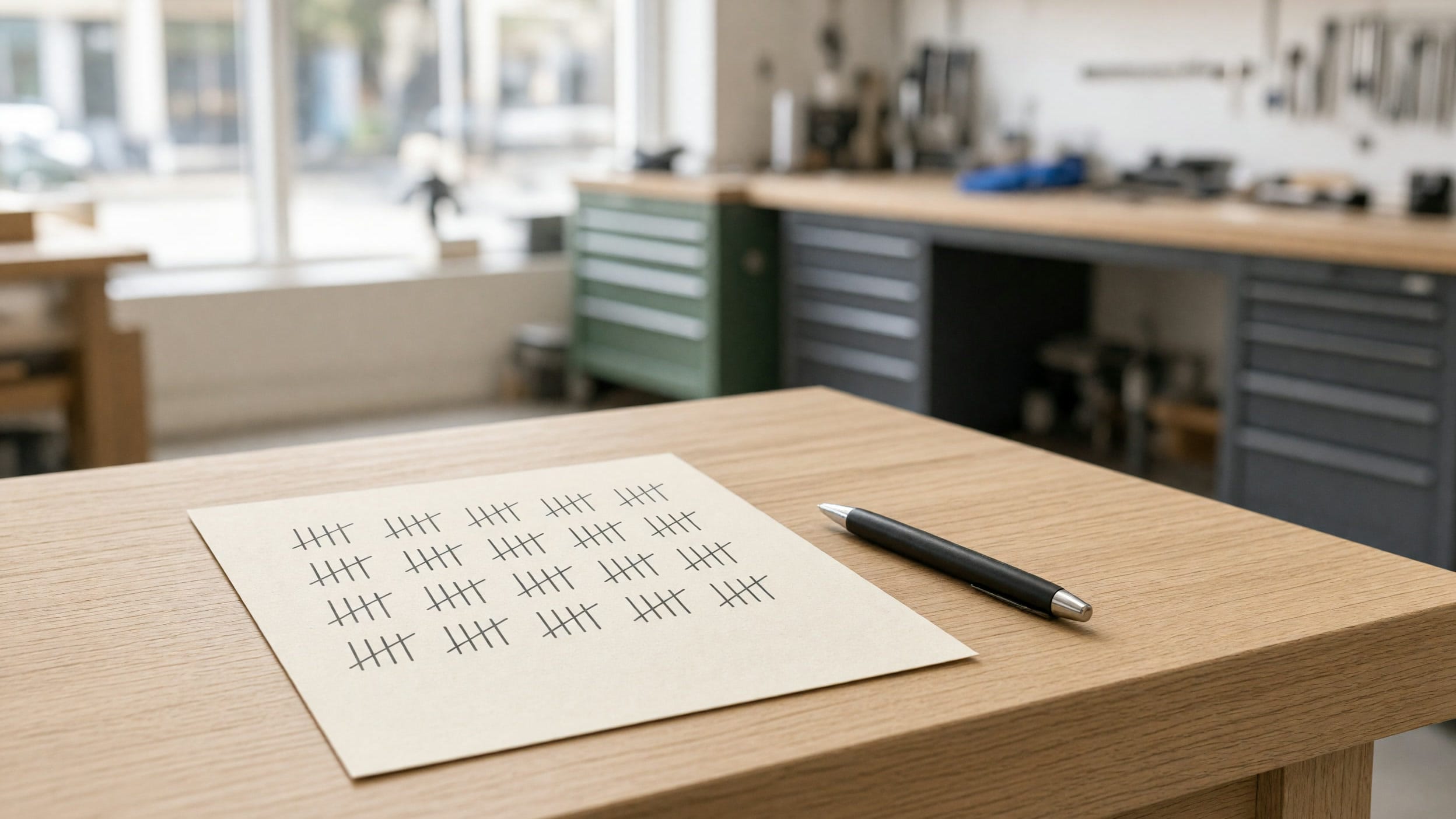
That Tuesday I got irritated enough to start a tally sheet. Not for any purpose. I put a piece of paper next to the till and made a mark every time the phone rang, and then because I had started I kept it going for the rest of the week.
Two hundred and fourteen marks by Saturday afternoon.
That number on its own is not interesting — a shop takes calls, that is what a shop with a phone in it does. What made me keep the sheet was the second column I started on Wednesday, when I began writing down what each call was actually about.
One hundred and eighty-six of the two hundred and fourteen were the same question. Is it ready yet.
And sixty of those hundred and eighty-six were about a bicycle that was already finished. Sitting on the shelf behind me. In some cases had been sitting there for two days, with a note on it, waiting for somebody to come and get it.
What a phone call actually costs
I want to be careful here, because the obvious version of this argument is wrong. The obvious version is that a phone call takes ninety seconds and two hundred calls is five hours and therefore we lost five hours. That is true and it is the least of it.
What a call actually costs is the interruption at the other end of it. The phone rings while I am halfway through booking somebody in at the counter. I stop, I answer, I go and look at a shelf, I come back, and the person in front of me has been standing there watching me do it. Half the time I have lost my place in what I was writing. A quarter of the time I forget to do the thing I was about to do, which is usually the thing that turns into next week's problem.
Or the phone rings while somebody is on a bench. They put down a tool, wipe their hands, walk to the front, look at a shelf, walk back, and find the wheel they had half-trued. Ten minutes, not ninety seconds, and a mechanic who is now slightly more annoyed than they were.
You cannot schedule around it because it arrives at random. It is not five hours of work, it is five hours of work distributed as two hundred small holes punched through everything else you were doing.
Why the job book could not help
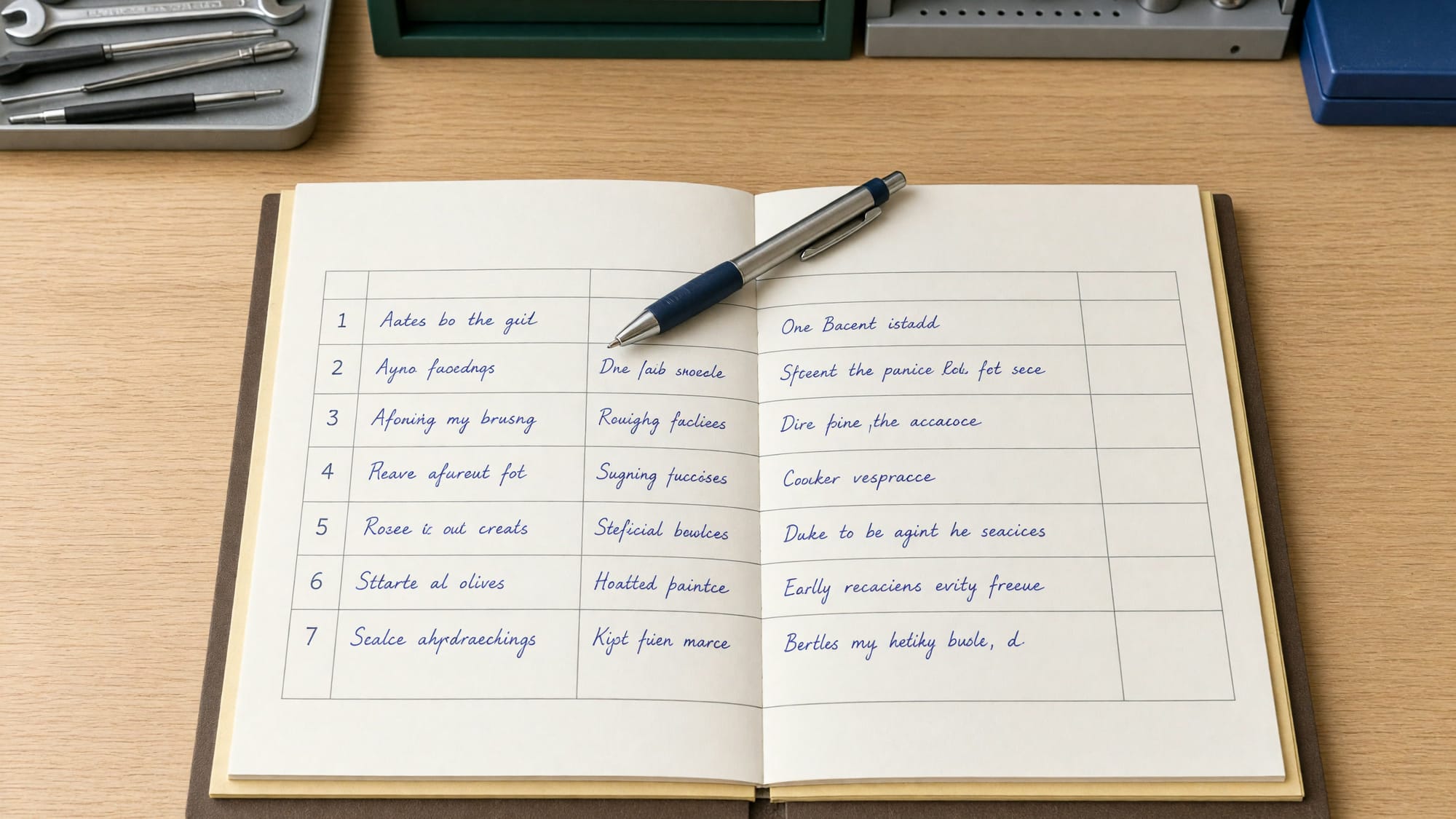
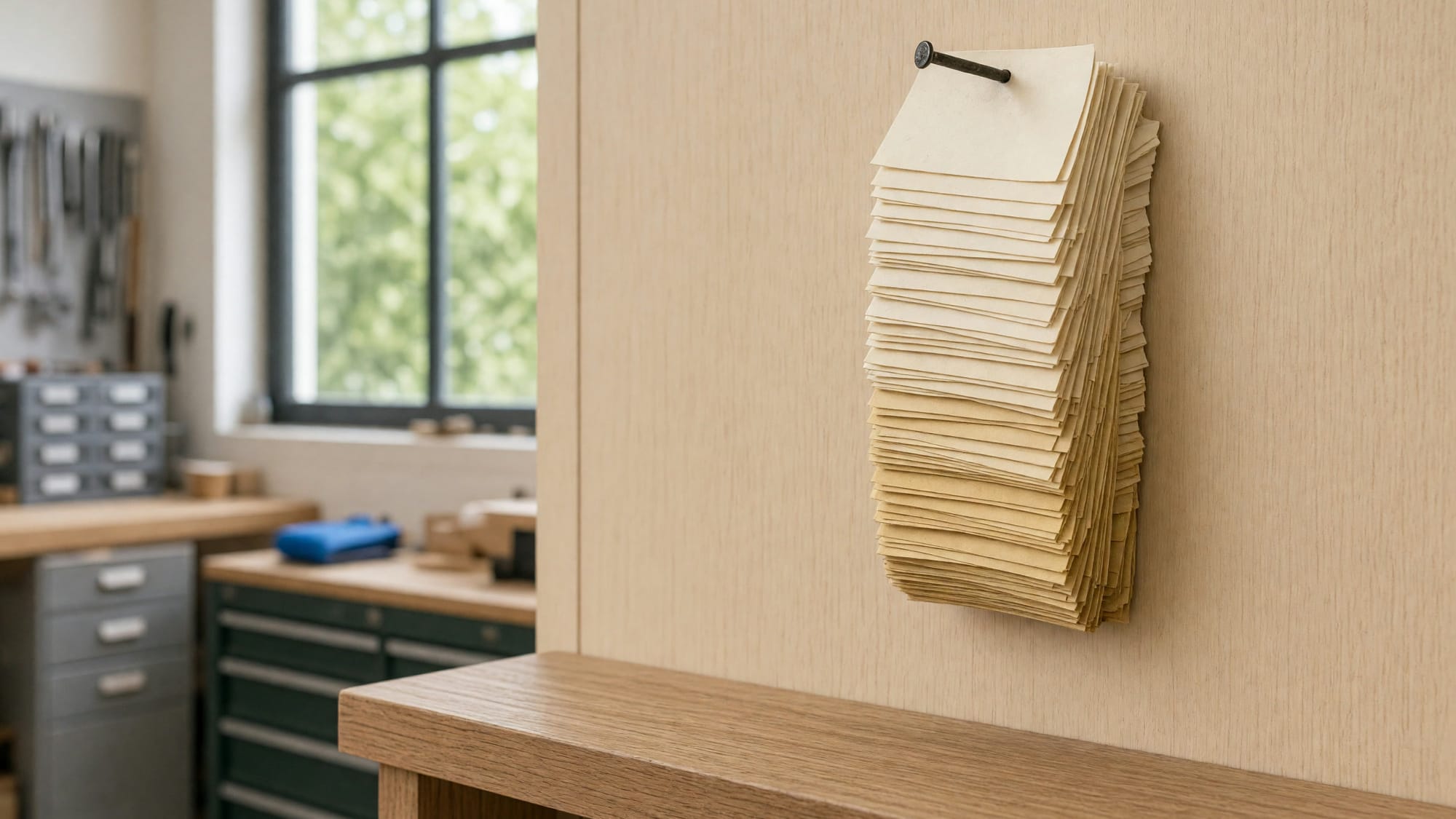
We had a job book. A carbonless duplicate pad — you write the job on the top sheet, the yellow copy underneath comes with it, one goes on a nail above the bench and one goes in a box. Everybody who has worked in a repair shop knows this object.
It is a good object. It is instant, it works when the power is out, you can hand somebody half of it as a receipt, and nobody has ever needed to be shown how it works.
And it cannot answer the question. It records what came in and what is wrong with it and roughly what it will cost. It does not record where the job has got to, because there is nowhere on it to write that down and no mechanism by which it would find out. The wheel got trued on Tuesday afternoon and the only thing in the shop that knows is the person who trued it, who is now at lunch.
So the answer to is it ready yet lived in one of two places: somebody's memory, or a shelf you had to physically walk to and look at. Both of those are fine when three people ask. Neither survives a hundred and eighty-six.
The shop knew the answer. There was just no way for the answer to leave the shop without somebody carrying it.
What I tried first
A whiteboard. Obviously a whiteboard — everybody tries a whiteboard.
It worked for about two weeks, which is exactly as long as it took for the shop to get busy enough that nobody updated it. A whiteboard is a thing you have to remember to change, and the moment it is wrong once it is worse than nothing, because now you have a board people trust that lies.
Then a whiteboard with magnets, one magnet per job, columns for the stages. This was better. It survived about six weeks and died the same death, plus a new one: magnets fall off, and a job that falls off a board stops existing.
Both of those failed for the same reason and it took me an embarrassingly long time to see it. Neither of them faces the customer. They are both devices for the shop to tell itself something, and the shop already knew. The problem was never that we could not find out where a job was. The problem was that the only channel from the shop's knowledge to the customer's head was a person, on a phone, one call at a time.
The thing that took six years to notice
I stopped working that counter in 2020. Theo and I started building the first version of what became Benchtop in 2021, and for a long time I described it to people as software for tracking repairs, which is accurate and completely misses the point.
Here is the actual point, and it is the one sentence in this piece I would keep if I had to throw the rest away:
Almost everything that happens at a service counter is somebody asking a question the shop already knows the answer to.
Not a hard question. Not a question requiring judgement. Is it ready. What is it going to cost. Did the part come. Every one of those has an answer, the answer exists, it is written down or it is in somebody's head three metres away, and the entire cost of the interaction is the transport.
Once you see it that way the whole thing inverts. You are not trying to answer questions faster. You are trying to make the answer available without a question having to be asked at all.
That is a smaller and more boring ambition than most software has, and it is the whole of what we do.
The tally sheet is in a drawer in the office. Two hundred and fourteen marks, in fives, in pencil.