

When nobody collects
Every repair shop has the shelf. Six finished things on it, three of them more than a month old, and one that both you and the person who owns it have privately stopped expecting to move.
Nobody writes about this because it is not interesting and it feels like a failure of admin. It is neither. It is a predictable consequence of finishing work for people, it costs you floor space and money, and it is almost entirely solvable with three messages and one written-down rule.
Why it happens
Not rudeness, and almost never forgetting in the ordinary sense.
They have moved on. The thing was broken, being without it became normal, and normal is sticky. A bicycle that has not been ridden for three weeks is no longer part of anybody's week.
They are embarrassed about the price. This is the big one and shops consistently underestimate it. Somebody who was quoted forty and told a hundred and ninety is not avoiding the bike, they are avoiding the conversation. Every week that passes makes the conversation worse, which makes the avoidance stronger.
They are waiting for a payday they did not mention. Extremely common and almost never said out loud, because saying it is worse than not collecting.
Two of those three are about money, and neither is fixed by another reminder that the job is ready. That is why the standard approach — send the same text again, more often — does not work.
What to say, and when
Three messages at three intervals, each doing a different job.
Day 3 — the plain one. Same information as the Ready message, no new tone. Assume they missed the first. Say the hours and say the amount. About a quarter of the shelf clears here and it costs nothing.
Day 14 — the one everybody gets wrong. The instinct is to apologise. Sorry to chase, no rush at all, whenever suits. That is polite and it is the reason the message fails: you have just told them there is no cost to continuing to do nothing.
The version that works is not rude, it is specific. It names the thing, names the amount, gives a real date, and mentions storage as a fact rather than a threat:
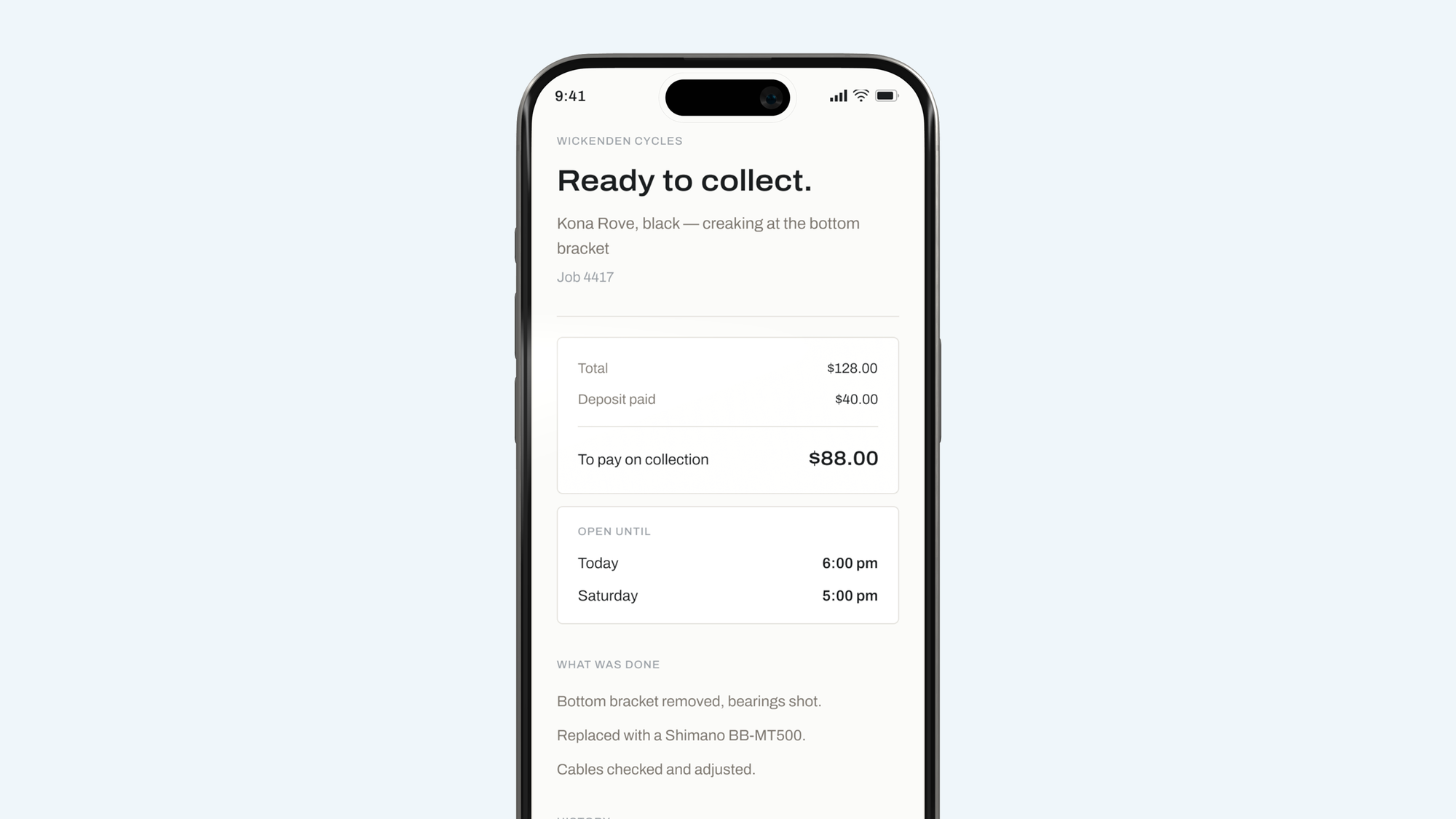
Wickenden Cycles: your Kona Rove has been ready since 24 May. $88 to pay. We keep finished work for 60 days and then have to charge for storage — could you let us know when you can get in?
The difference between that and the apologetic version is a date. A date converts a vague obligation into a decision.
Day 45 — the offer. By this point, if it is money, another reminder will not move it. Say something they can act on: pay by link and collect later, pay half now, or — the one that clears the oldest shelf items — offer to take the thing back for parts against the bill. Some of those conversations end with the customer relieved.
Write the policy down
One paragraph, on the wall and on the job card. It does not need to be legal language and it should not read like it:
| At | What happens | Who decides |
|---|---|---|
| 3 days | Reminder, plain | Automatic |
| 14 days | Reminder with a date and the storage note | Automatic |
| 45 days | A person makes contact with an offer | Whoever is on the counter |
| 60 days | Storage charged, at whatever your number is | Owner |
The value of writing it down is not enforcement. It is that the day-14 message can say we keep finished work for 60 days as a fact about the shop rather than as something you have just invented about this customer, which is the difference between a policy and a threat.
The legal bit, carefully
At some point the question becomes what you are actually allowed to do with something somebody has abandoned in your building. There are rules about this and they are genuinely different depending on where you are — different countries, and in some places different states or provinces, with different notice periods and different requirements about how you notify somebody before disposing of their property.
I am not going to tell you what they are, because I would get it wrong for most of the people reading this and it is the kind of wrong that costs money.
What to do is find out for your jurisdiction, once, and write the answer into the table above. Your trade association almost certainly has a page on it. It is an hour of somebody's time and you never have to do it again.
Prevention
Say the collection window out loud at intake, and write it on the card.
Not as a warning — as part of the ordinary sentence about how this works. We'll text you when it's done, and we keep things for sixty days. Eight words. The person who hears that at intake behaves measurably differently from the person who first encounters it in a chasing message six weeks later, because the second one reads as a rule invented about them.
The shelf never goes empty. Ours never did. But it stops being the same four things for a year.