
Set up your first job
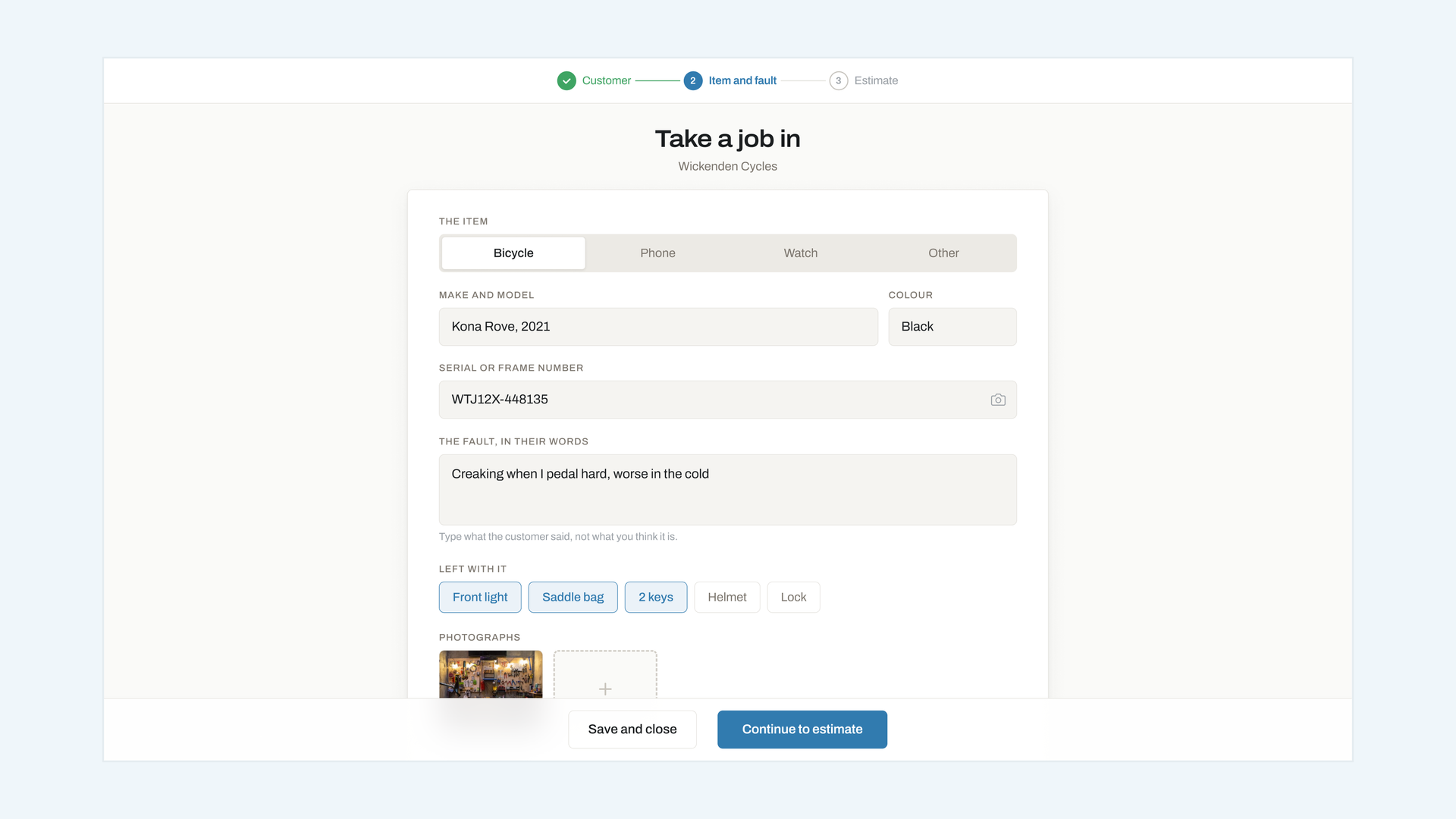
This takes about four minutes the first time and under a minute afterwards. You will need something to take in, a customer with a phone number, and nothing else.
Before you start
Three things worth having open:
- The thing itself, on the counter, so you can photograph it
- The customer's mobile number, which is the one field that has to be right
- Some idea of when you might have it done, even a rough one
You do not need to have decided a price. Prices go on as the work happens.
Take something in
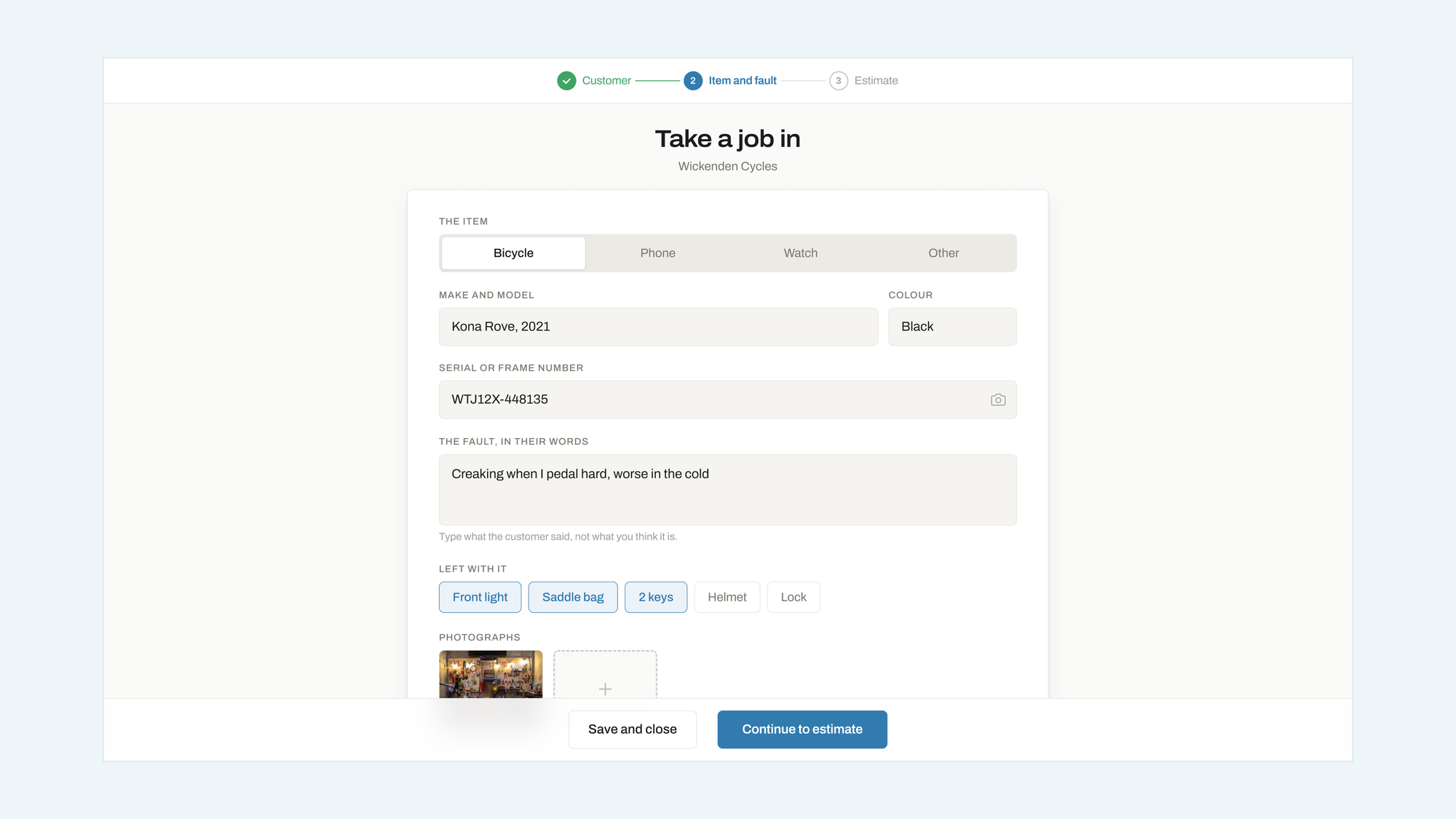
New job, then four fields:
| Field | What goes in it | Can it be empty |
|---|---|---|
| What is it | The object, plainly. `Kona Rove, black, 2021` | No |
| What is wrong | Their words, not yours. `Creaking when I pedal hard` | No |
| Customer | A name you will recognise at the counter | No |
| Mobile | Where the texts go | Yes, but then no texts |
That is the whole intake. Anything else — a promised date, a deposit, a second phone number — can go on later from the card.
Attach a photograph
Take it now rather than later. It costs about ten seconds while the thing is still in front of you, and it is the only moment when both of you agree on what condition it arrived in.
Photographs go on from whatever you are holding. Most shops use a phone in an apron pocket.
What the customer gets
The moment you save, they get one text: your shop's name, what you have taken in, and a link. The link opens a page with no login on it showing the status, the date it last changed, and eventually the total.
They will not need to ring you to ask whether it arrived, which is the smallest of the four messages and the one shops underestimate.
The one thing new shops get wrong
Putting the symptom in the description field and the object nowhere. "Creaking" is not a job. "Creaking at the bottom bracket" on a Kona Rove is a job, and in three weeks when somebody asks about it, only one of those can be found.
Next
Once something is on a bench, the next thing that usually happens is that it needs a part.